
Why I built a runner, what AI does not take away from a developer, and why I worry about the people starting out now.

Thomas Petersen · 23.11.2026 · 4 min read
The ten parts of the series are about how Nexus Runner works: the part of our development system Nexus that controls the AI sessions without being AI itself. This one is about why it exists. It has no gates and only a few numbers. It has the background for the other ten: where we came from, what made me go all the way, and what you still have to know when AI writes the code.
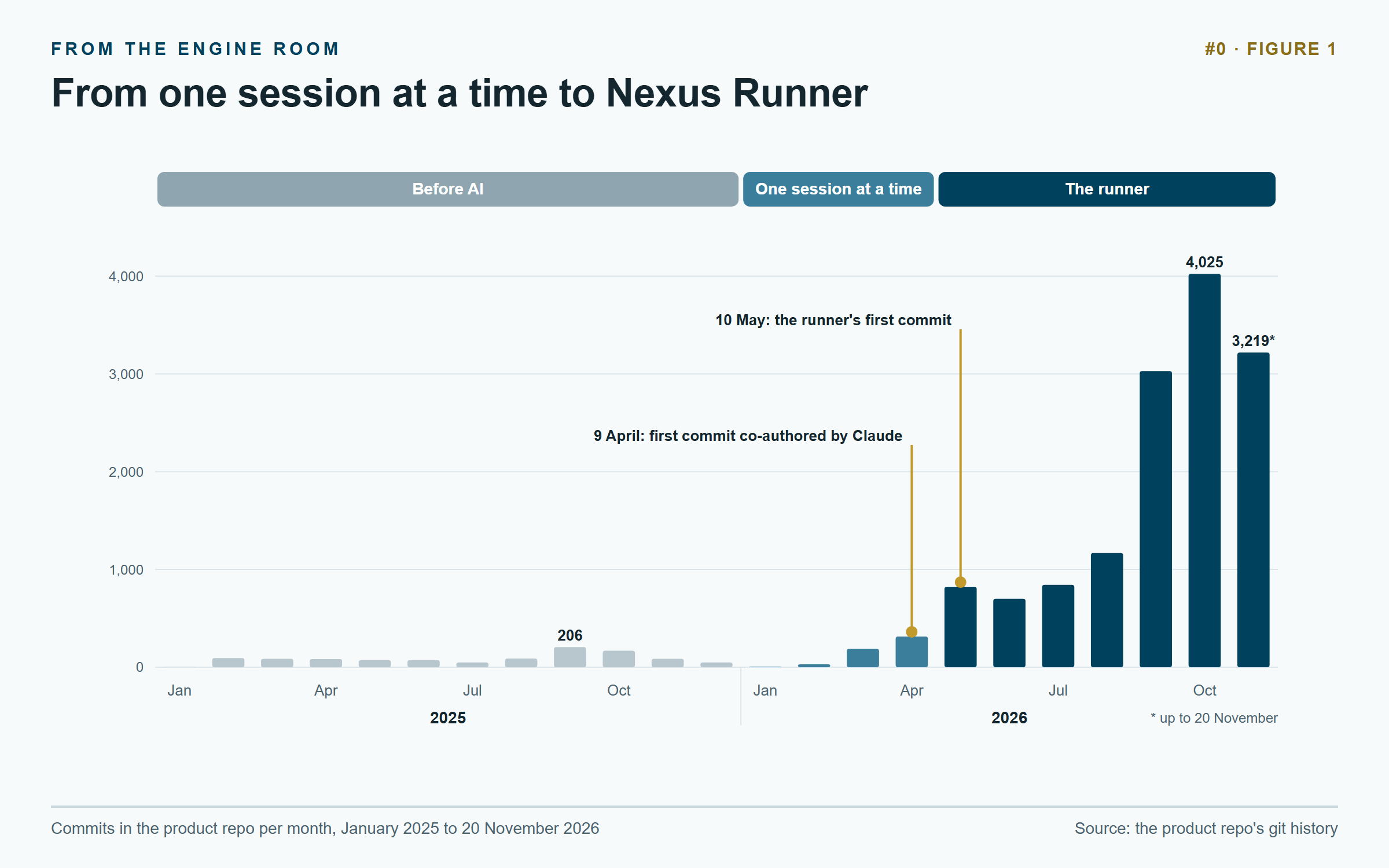
One session at a time
We started using AI for real at the beginning of 2026. It was Codex and Claude Code, and it was one session at a time, back and forth. I wrote, it answered, I read, corrected and wrote again. Nothing was automated.
It worked, the way it works for most people. A well-defined task was solved quickly and well. But I was the loop myself. Every task started and ended with me, and my attention was the limit on how much could get done.
You can see it in the git history. The whole of 2025 had just over 1,000 commits in the product repo. The first commit with Claude as co-author is from 9 April 2026.
All the way
Then agentic programming arrived for real: agents that do not just answer, but read the code, run commands, see the error and fix it themselves. I became aware of it through my network (thank you, Torsten Lund), and my first thought was that it had to be used to the fullest.
On 10 May the runner made its first commit. In October the product repo had more than 4,000 commits in a single month.
To the fullest did not mean giving the agents free rein. It meant the opposite. If many sessions are to work at the same time without me in the loop, something other than me has to keep track of what is done and what is right. That is what the ten parts are about.
To the fullest also meant that it had to pay off. From the start we have measured the runner on time and money. The first retrospective was held on 6 May, four days before the runner's first commit, and there have been 34 since. They measure the runner window against window: what a story costs, how long a task takes, how much gets blocked and how many findings come afterwards. That has been the guide all the way, and many of the decisions in the next parts started as a number in a retrospective (#10).
What I do not hand over to AI
My knowledge of security and architecture is the alpha and omega. We build multi-tenant solutions, where many customers' data lives in the same system and where the data design is enormously critical. A wrong decision in the data model is not a bug you fix in the next story. It can mean one customer's data showing up for another.
That is why the example the series follows is access per data type. Who may see what is exactly the kind of decision that must not be made by whoever writes the code. It was made in an interview where a session questioned me until the design was settled (#2), and every session after that has worked within it.
It is also the limit of what the runner can do. Gates can check that the code does what the design says. They cannot check that the design is right. Only someone who knows how a multi-tenant system goes wrong can do that, and you know it because you have built them yourself.
Tomorrow's developers
What worries me is the people starting out now. I know what good backend code looks like because I have written it myself for 20 years, the bad as well, and learned from it. A new graduate has learned the fundamentals in their education. But the experience you get under your fingernails by writing, failing and debugging yourself is not something you get there.
Unfortunately, I do not think young graduates will get the time to code the way we have until now without AI. When an agent can write the code in minutes, it is hard to justify a junior spending a week on it. But weeks like that are how you learn to spot what an agent gets wrong.
I do not have an answer to that. The runner certainly is not one. It assumes someone who already knows what is right.
Numbers as of 20 November 2026.
—
The code is written by AI. So is the text. The decisions are mine.

CTO of Performance Metrics. More than 20 years in backend development, ten of them as a consultant. Decides what the runner builds and lets AI write the code.
LinkedIn